The Complete History of Puerto Rican Cigars
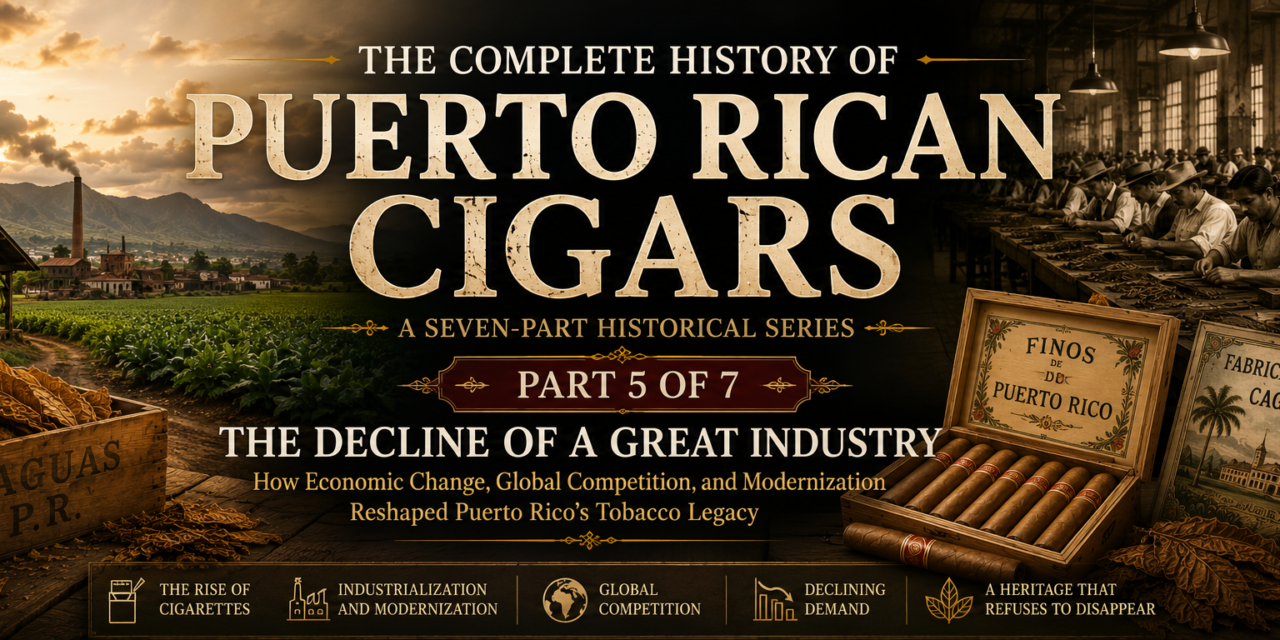
Part 5 of 7
The Decline of a Great Industry
How Economic Change, Global Competition, and Modernization Reshaped Puerto Rico’s Tobacco Legacy
For nearly a century, tobacco stood among Puerto Rico’s most important agricultural industries.
Thousands of families depended on tobacco farms, curing barns, cigar factories, transportation companies, and export businesses for their livelihood. Communities such as Caguas became synonymous with premium tobacco, while skilled torcedores earned respect for producing handcrafted cigars that reflected generations of experience.
From the outside, the future appeared bright.
But history often changes slowly.
Beginning in the mid-twentieth century, a series of economic, technological, and social shifts gradually transformed Puerto Rico’s tobacco industry. None of these changes alone ended the industry’s golden age. Together, however, they reshaped an entire way of life.
The Rise of the Cigarette
One of the most significant changes came from changing consumer preferences.
Throughout much of the twentieth century, factory-produced cigarettes became increasingly popular around the world.
They were inexpensive.
Convenient.
Mass-produced.
Heavily advertised.
Consumers who once enjoyed hand-rolled cigars often turned toward cigarettes, particularly during and after World War II.
Demand for premium cigars declined in many markets.
For Puerto Rican cigar manufacturers, the change was impossible to ignore.
Industrialization Changes Puerto Rico
The island itself was also changing.
Following World War II, Puerto Rico launched an ambitious economic development initiative commonly known as Operation Bootstrap.
Government leaders encouraged manufacturing, industrial investment, and urban development.
Many workers who had spent generations in agriculture found new opportunities in factories, construction, and expanding cities.
Young people increasingly left rural communities in search of different careers.
As farms lost experienced workers, tobacco production naturally declined.
Global Competition Intensifies
Puerto Rico also faced growing competition from other cigar-producing nations.
Cuba continued to enjoy worldwide recognition for its premium cigars.
The Dominican Republic expanded rapidly as an international cigar producer.
Nicaragua and Honduras developed thriving premium tobacco industries during the latter half of the twentieth century.
Each country offered unique growing regions, experienced cigar makers, and increasing production capacity.
Puerto Rico remained respected for its craftsmanship, but competing in a rapidly changing global marketplace became more difficult.
Consolidation Within the Industry
As demand shifted, many smaller tobacco businesses struggled to survive.
Larger corporations purchased or absorbed smaller operations.
Some family-owned factories closed after generations in business.
Others diversified into different agricultural products or left the tobacco industry altogether.
Communities that had once depended upon tobacco gradually saw fewer curing barns, fewer cigar factories, and fewer tobacco farms.
The decline was gradual.
But it was unmistakable.
Changing Consumer Habits
Smoking itself began to change.
Scientific research highlighting the health risks associated with tobacco influenced public opinion throughout the second half of the twentieth century.
Governments introduced advertising restrictions.
Warning labels became mandatory.
Public smoking regulations expanded.
Although premium cigars continued to appeal to enthusiasts, overall tobacco consumption patterns evolved significantly.
The industry adapted, but the marketplace was no longer the same.
A Heritage Refuses to Disappear
Despite decades of decline, Puerto Rico’s cigar tradition never vanished.
Dedicated farmers continued cultivating tobacco.
Experienced torcedores preserved techniques passed from one generation to the next.
Collectors sought vintage Puerto Rican cigar boxes, labels, and memorabilia.
Museums and historical organizations documented the industry’s remarkable past.
What had once been a major economic engine evolved into a treasured cultural heritage.
Lessons From History
The decline of Puerto Rico’s tobacco industry was never simply about cigars.
It reflected broader changes in technology, transportation, economics, labor, public health, and globalization.
Industries evolve.
Markets change.
Consumer preferences shift.
Yet craftsmanship and tradition often survive long after large-scale production has faded.
Puerto Rico’s tobacco story demonstrates exactly that.
A New Generation Begins Looking Back
Ironically, as global appreciation for premium handcrafted cigars has grown in recent decades, many enthusiasts have rediscovered Puerto Rico’s tobacco heritage.
Small boutique manufacturers have emerged.
Local cigar lounges have expanded.
Visitors increasingly seek authentic experiences rooted in Puerto Rico’s history and culture.
The industry’s future may never resemble its past.
But its story is far from over.
Coming Next
Part 6 of 7
The Revival of Puerto Rican Cigars
Discover how boutique cigar makers, artisan torcedores, local tobacco farms, premium cigar lounges, and a new generation of entrepreneurs are preserving—and reimagining—Puerto Rico’s cigar tradition for the twenty-first century.
This article creates a natural bridge into Part 6, where the tone becomes optimistic again. Rather than ending the series on decline, the final two installments will highlight today’s boutique producers, cigar culture, tourism, and the opportunities that still exist for Puerto Rican cigars to carve out a distinctive place in the premium cigar market.