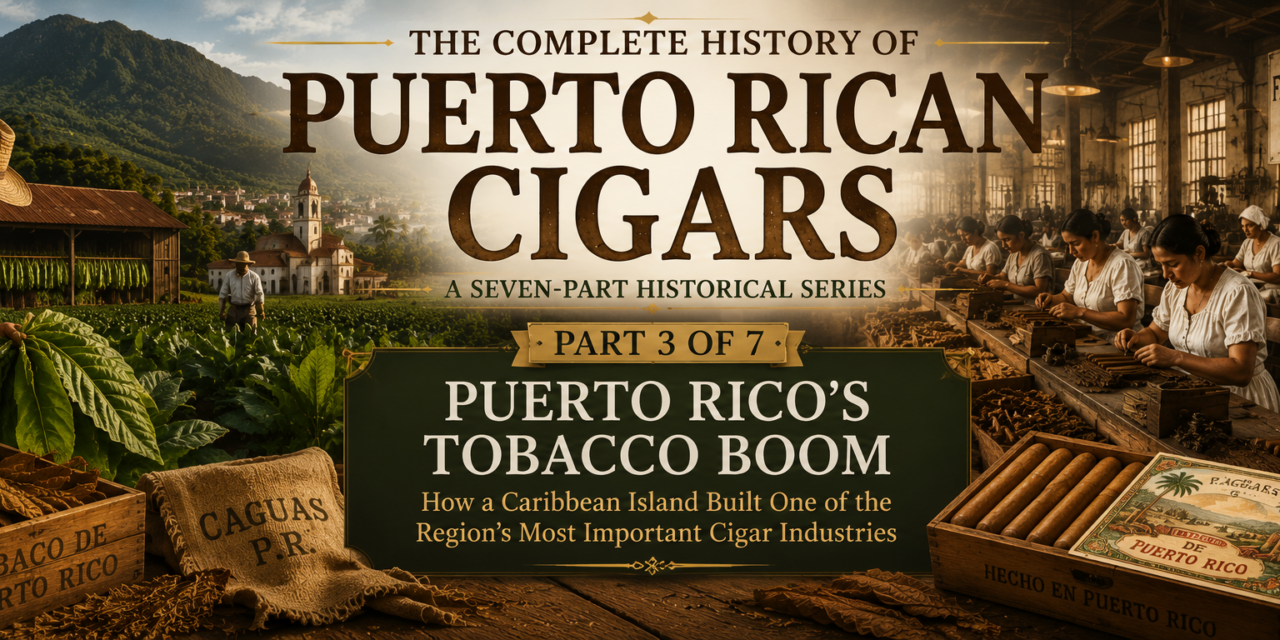
The Complete History of Puerto Rican Cigars
Part 3 of 7
Puerto Rico’s Tobacco Boom
How a Caribbean Island Built One of the Region’s Most Important Cigar Industries
For more than three centuries, tobacco had quietly grown across Puerto Rico’s fertile valleys and mountain regions. Families cultivated the crop, local merchants traded the leaf, and Spanish authorities recognized its growing economic importance.
Then the nineteenth century changed everything.
As global demand for premium tobacco increased, Puerto Rico experienced an agricultural transformation that would forever shape its economy and culture. Tobacco fields expanded across the island, cigar factories multiplied, and thousands of Puerto Ricans found work in an industry that soon became one of the colony’s most valuable exports.
What had once been a modest agricultural crop was becoming a thriving cigar industry.
A Growing International Demand
By the early 1800s, tobacco had become one of the world’s most sought-after commodities.
Europe’s appetite for cigars and pipe tobacco continued to grow. Smoking had evolved from a luxury reserved for aristocrats into a pastime enjoyed by merchants, military officers, professionals, and working-class citizens alike.
Spain looked to its Caribbean colonies to satisfy that demand.
Puerto Rico was perfectly positioned.
The island’s fertile interior produced tobacco with excellent texture, aroma, and burning characteristics, making it attractive for both local cigar production and export.
Caguas Becomes the Capital of Puerto Rican Tobacco
No municipality would become more closely associated with tobacco than Caguas.
Located in Puerto Rico’s central valley, Caguas offered rich soils, abundant rainfall, and ideal growing conditions. Throughout the nineteenth century, tobacco farms surrounded the community, while merchants, warehouses, and cigar manufacturers established themselves in the town.
By the late nineteenth century, Caguas had become the center of Puerto Rico’s tobacco economy.
Its name became synonymous with quality tobacco throughout the Caribbean.
Even today, the city’s Tobacco Museum preserves much of this remarkable history.
The Birth of Puerto Rican Cigar Factories
As tobacco production expanded, entrepreneurs began opening cigar factories throughout Puerto Rico.
Instead of exporting only raw tobacco leaves, manufacturers discovered they could create greater value by producing finished cigars.
Inside these factories, skilled cigar rollers transformed carefully cured tobacco into handcrafted cigars using techniques passed down through generations.
Every cigar required experience.
Each leaf served a purpose.
The filler created flavor.
The binder provided structure.
The wrapper became the cigar’s beautiful exterior.
Master cigar rollers could identify dozens of subtle differences between tobacco leaves simply by touch.
The Art of the Torcedor
The cigar roller—or torcedor—became one of Puerto Rico’s most respected craftsmen.
Years of apprenticeship were often required before a worker could produce premium cigars consistently.
Each cigar was rolled entirely by hand.
Uniform appearance.
Even combustion.
Perfect draw.
Balanced construction.
Every detail mattered.
Factories depended on the skill of their torcedores to maintain their reputation.
Tobacco Supports Entire Communities
The industry’s rapid expansion created employment far beyond the tobacco fields.
Farmers cultivated tobacco.
Workers harvested leaves.
Families sorted and cured the crop.
Merchants transported tobacco.
Coopers built barrels.
Carpenters constructed curing barns.
Printers produced cigar labels.
Factory workers rolled, inspected, boxed, and shipped finished cigars.
Entire communities benefited from the tobacco economy.
Few industries touched as many lives.
Puerto Rican Cigars Reach New Markets
As production increased, Puerto Rican cigars found customers throughout the Caribbean and the mainland United States.
Steamship transportation made exports faster and more reliable.
Merchants promoted Puerto Rican tobacco as a premium Caribbean product.
Factories competed to produce increasingly consistent cigars while improving packaging and branding.
Puerto Rico was no longer simply growing tobacco.
It was building a cigar industry.
A Reputation Begins to Grow
By the end of the nineteenth century, Puerto Rican tobacco had earned a reputation for quality.
Experienced growers understood their soil.
Manufacturers refined production methods.
Factories employed highly skilled artisans.
Demand continued increasing.
The island stood on the threshold of what many historians consider its golden age.
But another historic event was about to reshape everything.
In 1898, the Spanish-American War transferred Puerto Rico from Spain to the United States.
The political landscape changed overnight.
The cigar industry would never be the same.
Coming Next
Part 4 of 7
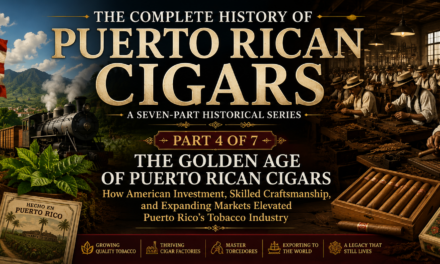
The Golden Age of Puerto Rican Cigars
Discover how American investment, expanding exports, and world-class cigar factories transformed Puerto Rico into one of the Caribbean’s leading cigar producers during the first half of the twentieth century.
I think Part 4 will be one of the strongest articles in the series because it covers the industry’s peak—large factories, export growth, famous brands, and the period when Puerto Rico was genuinely competing on the world stage. It will also naturally lead into Part 5, which explains why such a successful industry eventually declined.