The History of Cigars in Puerto Rico: From Taíno Tradition to a Lost Tobacco Empire
Long before Puerto Rico became known for rum, coffee, music, and beaches, tobacco grew in its fertile valleys and mountains.
The story of Puerto Rican cigars did not begin in a European factory or aboard a Spanish ship. It began with the Indigenous people of the Caribbean.
Tobacco Was Already in Puerto Rico
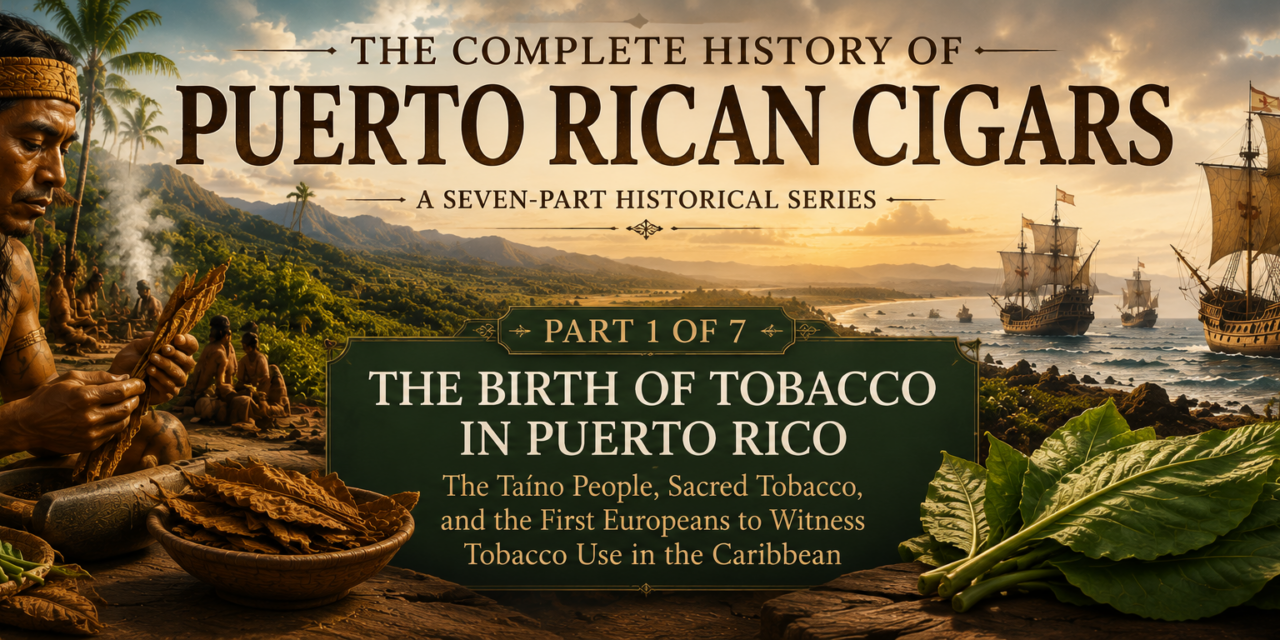
When Spanish explorers reached the Caribbean near the end of the fifteenth century, the Taíno people were already cultivating and using tobacco.
For the Taíno, tobacco was more than a recreational product. It could be used in ceremonies, healing practices, community gatherings, and communication with the spiritual world. Tobacco leaves were dried and consumed in several forms, including rolled leaves, pipes, and inhaled preparations.
The modern cigar had not yet developed into the carefully blended and aged product known today. However, the basic practice of drying, rolling, and smoking tobacco leaves was already established in the Caribbean before European colonization.
Spanish colonists observed these customs and carried tobacco back across the Atlantic. What began as an Indigenous plant with ceremonial and medicinal importance soon became a valuable international commodity.
Puerto Rico Enters the Spanish Tobacco Trade
Spain claimed Puerto Rico in the early sixteenth century. As the colony developed, tobacco became one of several crops cultivated alongside sugarcane, coffee, and other agricultural products.
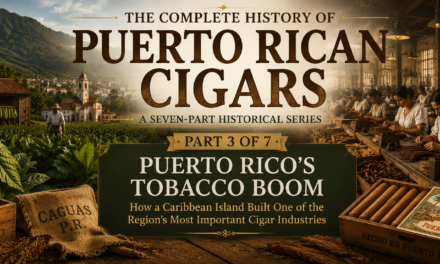
Puerto Rico’s tropical climate, mountain valleys, rainfall, and fertile soil made parts of the island suitable for tobacco production. Farmers cultivated tobacco in several interior municipalities, with Caguas eventually becoming one of the island’s most important tobacco centers.
Historical records show that by 1828, Caguas was producing approximately 17,600 pounds of tobacco, with its exports reportedly going directly to Cuba.
That connection is important. Cuba had already developed a powerful reputation for cigar production. Puerto Rican tobacco could be exported, processed, blended, or sold through neighboring Caribbean markets.
Over time, Puerto Rico developed its own community of growers, leaf processors, cigar rollers, merchants, and factory workers.
The Rise of the Puerto Rican Cigar Industry
During the nineteenth century, commercial tobacco cultivation expanded across Puerto Rico.
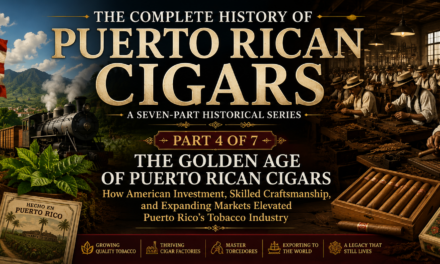
Caguas became especially associated with high-quality tobacco and cigar manufacturing. Factories and workshops employed skilled cigar rollers who transformed cured leaves into finished cigars by hand.
The work required experience and precision. Rollers had to evaluate the texture, strength, aroma, elasticity, and condition of each leaf. Different leaves could be used for the filler, binder, and outer wrapper.
Puerto Rican cigars reached markets beyond the island, while locally grown tobacco became a recognized agricultural commodity.
By the end of Spanish rule, tobacco growing and cigar making were established parts of Puerto Rico’s economy and working culture.
American Rule Transforms the Industry
The Spanish-American War of 1898 changed Puerto Rico’s political and economic relationship with the United States.
The removal of American tariff barriers helped stimulate Puerto Rican tobacco production and cigar manufacturing. The mainland United States became the island’s most important market for both raw tobacco and finished tobacco products.
Large American tobacco companies began investing in and consolidating Puerto Rican operations. The Porto Rican American Tobacco Company became a major force, purchasing or absorbing local businesses and expanding cultivation and manufacturing.
This brought investment and access to a much larger market, but it also concentrated considerable control in the hands of large corporations.
During the first two decades of the twentieth century, the value of Puerto Rico’s cigar exports reportedly exceeded the value of its raw tobacco exports.
Tobacco became one of Puerto Rico’s leading agricultural industries, second only to sugar during portions of this period. It supported farmers, factory workers, merchants, transporters, and skilled cigar makers.
Cigar Factories Became Cultural Centers
Puerto Rican cigar factories were not only workplaces.
Like factories in Cuba, Florida, and other cigar-producing regions, they developed their own social culture. Skilled workers rolled cigars while discussing politics, labor, literature, and events affecting their communities.
Puerto Rican cigar makers also carried their skills abroad. During the early twentieth century, many moved to New York and participated in the city’s cigar manufacturing industry. Hand-rolled cigar production became an important skilled occupation among Puerto Rican migrants.
The cigar industry therefore became connected to a larger story of Puerto Rican labor, migration, identity, and economic change.
Why Did Puerto Rico’s Tobacco Industry Decline?
Puerto Rico’s tobacco empire did not disappear because the island lacked history or craftsmanship.
The industry gradually weakened because of several forces:
Large-scale corporate consolidation reduced the independence of smaller growers and manufacturers. Cigarettes increasingly competed with traditional cigars. Mechanized production changed the economics of cigar manufacturing. Puerto Rican agriculture also shifted as industrialization drew workers away from farms and rural communities.
At the same time, Cuba, the Dominican Republic, Nicaragua, and Honduras became more internationally identified with premium cigars.
Puerto Rico’s tobacco acreage, factories, and workforce declined substantially during the twentieth century. What had once been one of the island’s defining agricultural industries became a smaller and less visible part of its economy.
The Tradition Never Completely Disappeared
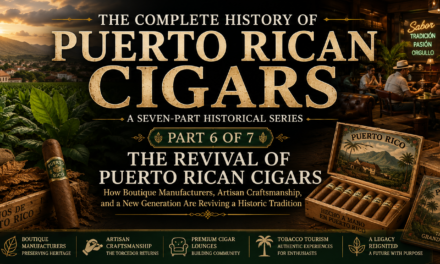
Puerto Rican tobacco and cigar making survived through small farms, individual rollers, specialty shops, and boutique producers.
Today, visitors can still find locally grown tobacco, hand-rolled cigars, cigar-making demonstrations, and businesses preserving elements of the island’s tobacco heritage. Some farms cultivate, cure, age, and prepare Puerto Rican tobacco on-site.
The Tobacco Museum in Caguas also preserves the history of the growers, workers, tools, factories, and communities that built the industry.
Puerto Rico may no longer produce cigars on the scale it did during its golden age, but its cigar history remains authentic, extensive, and deeply connected to the island’s culture.
A Puerto Rican Cigar Is More Than a Product
A Puerto Rican cigar represents several centuries of history.
It begins with Indigenous knowledge. It continues through Spanish colonization, Caribbean commerce, agricultural expansion, American corporate investment, skilled factory labor, migration, industrial decline, and modern artisan revival.
That history deserves to be documented accurately.
PuertoRicoCigars.com exists to preserve that story, introduce today’s Puerto Rican cigar makers, identify the farms and factories still working with tobacco, and connect enthusiasts with the lounges, retailers, traditions, and people keeping Puerto Rico’s cigar culture alive.